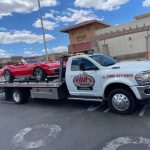
Yes, a car can usually be towed after a wheel comes off, but the missing wheel changes how the vehicle must be supported, loaded, and transported. Professional towing operators must consider the condition of the exposed wheel assembly, surrounding suspension components, and vehicle undercarriage before determining an appropriate transportation method.
Losing a wheel while driving or discovering that one has detached from a parked vehicle can create an unexpected transportation problem. Unlike a flat tire, where the wheel remains connected to the vehicle, complete wheel separation can leave part of the vehicle resting dangerously close to the ground.
For drivers in Queen Creek, AZ, this situation can occur on residential streets, parking lots, or busy roads. Understanding what makes wheel-loss towing different can help vehicle owners recognize why professional transportation is necessary.
What Happens to a Car When a Wheel Comes Off?
A vehicle depends on its wheels and suspension components to support its weight and maintain proper contact with the road.
When a wheel separates from its mounting point, that support is lost at the affected corner. Depending on the circumstances, the vehicle may drop onto its brake rotor, suspension assembly, or another component.
The remaining wheels may still be attached and functional, but that does not mean the vehicle can move normally.
A missing wheel can change the vehicle’s balance, ground clearance, and ability to roll.
Why Complete Wheel Separation Is Different From a Flat Tire
A flat tire generally leaves the wheel assembly connected to the vehicle. Although the tire may no longer support the vehicle properly, the wheel remains attached to its hub.
Complete wheel separation creates a more complicated situation.
The wheel and tire may be entirely disconnected, leaving the hub, brake components, or suspension exposed.
This distinction matters because ordinary towing arrangements may rely on the vehicle’s wheels to support some of its weight or allow controlled movement during loading.
When one wheel is missing, those assumptions no longer apply.
What Components May Be Affected?
The extent of damage depends on how the wheel separated and what happened immediately afterward.
Possible areas of concern include:
• Wheel studs and mounting hardware
• Wheel hub and bearing assembly
• Brake rotor, caliper, or brake lines
• Suspension arms and steering components
• Fender, bumper, and underbody panels
• Nearby drivetrain components
These parts are not necessarily damaged in every incident. However, their condition can influence how the vehicle should be transported.
A mechanical inspection is generally needed to determine the full extent of damage before the car returns to road use.
Can a Light Duty Tow Truck Move a Vehicle With a Missing Wheel?
A light duty tow truck can often transport a passenger car with a missing wheel when the appropriate lifting, loading, and vehicle-support equipment is available.
The principal challenge is not simply lifting the vehicle. It is managing the unsupported corner without placing additional weight or movement-related stress on damaged components.
For example, a sedan missing its front-left wheel may have limited clearance beneath the front suspension. Attempting to move it as though all four wheels were intact could cause exposed mechanical components to contact the ground.
A professional towing operator must consider these limitations when choosing how to access and move the vehicle.
Why Vehicle Position Matters
A car that loses a wheel may not remain level.
The affected corner can drop significantly, leaving the undercarriage closer to the pavement.
This can make conventional loading angles unsuitable because the vehicle may contact the towing equipment before it reaches the intended position.
The problem may become more complicated if the vehicle stopped on uneven ground, near a curb, or in a restricted parking area.
Vehicle position therefore plays an important role in selecting the appropriate transportation approach.
How Do Towing Operators Transport Cars With Missing Wheels?
Professional towing arrangements vary according to the vehicle’s condition, available equipment, and surrounding environment.
A vehicle with one missing wheel may require temporary support under the affected corner during loading. The operator must also account for how the car will remain stable while being transported.
Different vehicles may require different approaches.
Supporting the Affected Corner
When a wheel is missing, the vehicle cannot rely on that corner to roll or support its normal share of weight.
Depending on the damage, a towing operator may use suitable vehicle-handling equipment to support or reposition the affected area.
The objective is to prevent unnecessary contact between damaged components and the loading surface.
Support must be appropriate for the vehicle’s structure and condition. Not every exposed suspension or brake component can safely bear the forces involved.
Considering Flatbed Transportation
A flatbed may be an appropriate transportation option because it allows the disabled car to be carried on a platform rather than requiring its remaining wheels to roll along the roadway.
However, having a flatbed available does not automatically solve the loading problem.
The vehicle still needs to be positioned on the platform without dragging or placing damaging pressure on the unsupported corner.
Additional loading equipment or another transportation arrangement may be necessary depending on the circumstances.
Securing the Vehicle
Once loaded, the car must be secured in a way that accounts for its damaged condition.
A missing wheel can change the vehicle’s resting position and eliminate a normal wheel-based securement point.
Professional operators must use approved attachment and support methods suitable for the specific vehicle and equipment.
The goal is to maintain vehicle stability during transportation without relying on damaged or unsuitable components.
Why Is a Missing Wheel a Serious Road Safety Concern?
Wheel separation can affect vehicle control and create hazards for surrounding traffic.
If a wheel detaches while the vehicle is moving, the sudden loss of support may cause the car to drop toward the pavement. The separated wheel may also continue moving independently, potentially creating an additional roadway hazard.
The National Highway Traffic Safety Administration has documented wheel-separation concerns in vehicle safety recalls. These incidents demonstrate why wheel attachment failures should be treated as serious mechanical problems.
A vehicle that has lost a wheel should not be driven, even if its engine and transmission continue functioning.
Emergency towing may be necessary when the vehicle is disabled in traffic or another location where it cannot remain safely.
The immediate transportation concern is moving the disabled vehicle without creating additional danger for motorists, pedestrians, or roadside personnel.
Does It Matter Which Wheel Has Come Off?
Yes. The location of the missing wheel can influence the towing approach because different corners of the vehicle contain different steering, suspension, braking, and drivetrain components.
Front Wheel Separation
When a front wheel detaches, steering components may be exposed to additional damage.
Most passenger vehicles rely on their front wheels for directional control. Many also use front-wheel drive, meaning the front wheels are connected to components responsible for transmitting engine power.
A missing front wheel can therefore affect both the vehicle’s support and the condition of nearby mechanical assemblies.
The towing method must account for the damaged corner and any components that could interfere with movement.
Rear Wheel Separation
A missing rear wheel also creates substantial transportation challenges.
Depending on the vehicle, the affected area may include rear suspension components, brake assemblies, and drivetrain connections.
Even when the front steering system remains functional, the vehicle cannot be treated as normally movable.
A rear-wheel-drive car may present additional concerns involving the drive axle or related components.
The appropriate transportation method depends on the vehicle’s design and the condition of the exposed assembly.
How Does Wheel Separation Affect Different Passenger Vehicles?
Vehicle weight, dimensions, drivetrain configuration, and ground clearance all influence transportation requirements.
A compact sedan missing a wheel may need a different loading arrangement from a larger SUV with comparable damage.
Sedans and Compact Cars
Smaller passenger vehicles often have relatively low ground clearance.
When a wheel separates, the affected corner may sit close to the pavement, increasing the likelihood of contact between exposed components and the ground.
This can complicate loading, especially when the vehicle is positioned on an incline or uneven surface.
SUVs and Crossovers
SUVs and crossovers vary in weight, wheelbase, and suspension design.
Although some have greater ground clearance than sedans, losing a wheel can still cause substantial changes in vehicle height and balance.
All-wheel-drive configurations may also influence the transportation method.
The towing operator must account for both the missing wheel and the vehicle manufacturer’s towing requirements.
Pickup Trucks
Light-duty pickup trucks can also experience wheel separation.
Their greater weight, larger dimensions, and possible cargo loads can affect equipment selection.
A pickup carrying tools or other materials may present different loading and weight-distribution considerations from an unloaded vehicle.
These differences demonstrate why the appropriate towing approach should be based on the actual vehicle rather than its category alone.
What Makes Towing a Car With a Missing Wheel More Complicated?
Several circumstances can make the transportation process more demanding.
Restricted Access
A vehicle missing a wheel may be difficult to move if it is parked close to another car, wall, curb, or building.
Limited access can restrict the positioning of towing equipment and complicate support of the damaged corner.
For example, a sedan that loses a wheel in a narrow parking space may require a different loading arrangement from one stopped in an open area.
Additional Collision Damage
Some wheel separations occur during or after a collision.
In these situations, damage may extend beyond the missing wheel assembly.
Bent suspension components, damaged body panels, or compromised structural areas may affect the vehicle’s stability and suitable attachment points.
The transportation approach must consider the combined damage rather than treating the missing wheel as the only problem.
Uneven Ground
A car that loses a wheel on a slope or uneven surface may rest at an unusual angle.
This can influence how the vehicle’s weight is distributed and how the unsupported corner can be managed.
The available loading space and surface conditions become important considerations when planning transportation.
Why Is Professional Towing Preferable to Moving the Vehicle Normally?
A missing wheel creates a mechanical limitation that cannot be resolved by simply placing the transmission in neutral.
The affected corner lacks the normal support required for controlled rolling movement.
Forcing the vehicle to move without appropriate support can damage brake assemblies, suspension components, and other parts that may already have been affected by the incident.
Professional towing addresses the transportation problem by considering the vehicle’s actual condition.
The operator can determine whether the car requires additional support, which towing configuration is appropriate, and how the vehicle can be secured.
These decisions are especially important when the vehicle is located near traffic or has suffered additional damage.
For drivers seeking Light duty towing in Queen Creek, the relevant consideration is whether the available service and equipment can accommodate a vehicle that no longer has all four wheels attached.
A suitable towing arrangement can transport the car to its destination without requiring it to operate in an unsafe mechanical condition.
Where Should a Car Be Taken After Losing a Wheel?
A vehicle that has experienced wheel separation generally needs inspection by a qualified automotive repair provider.
The required repairs depend on the cause of the separation and whether surrounding components were damaged.
Possible repair considerations may involve the wheel hub, mounting hardware, suspension, steering system, or brakes.
The transportation destination should therefore be a location appropriate for receiving a disabled vehicle.
A repair facility may also need suitable access for unloading a car with limited ground clearance or an unsupported corner.
Coordinating the destination helps connect the immediate towing need with the subsequent mechanical evaluation.
It is important to distinguish between transportation and repair. A towing service moves the disabled vehicle, while a qualified repair provider determines whether it can safely return to normal operation.
What Should Drivers Understand About Wheel-Loss Towing?
The most important consideration is that a car can often be transported even when one of its wheels is completely missing.
However, the missing wheel changes the conditions under which the vehicle can be moved.
The exposed assembly, altered vehicle height, damaged components, and available access can all influence the towing arrangement.
A light duty tow truck may be appropriate for the vehicle’s size, but additional support or loading considerations may be necessary.
Professional transportation is particularly important when the vehicle cannot roll normally or when mechanical damage may extend beyond the missing wheel.
By accounting for these factors, a towing company can determine a transportation method suited to the vehicle’s condition.
For drivers in Queen Creek and surrounding communities, understanding these limitations helps explain why wheel separation calls for professional assistance rather than ordinary vehicle movement.
Professional Transportation After Wheel Separation
Losing a wheel can leave a vehicle completely immobilized, but it does not necessarily prevent transportation.
The appropriate towing method depends on the vehicle’s design, the affected wheel position, the extent of mechanical damage, and the conditions at the breakdown location.
Professional towing provides a way to move the disabled car toward inspection and repair while accounting for the additional challenges created by the missing wheel.
Rather than focusing solely on moving the vehicle, the transportation decision should prioritize appropriate support, loading, and securement throughout the operation.
About Evan’s Towing & Recovery LLC
Evan’s Towing & Recovery LLC is a family-owned towing business serving Queen Creek, Arizona, and surrounding East Valley communities. Founded in 2019, the company provides light-duty towing, vehicle recovery, and roadside assistance, and identifies itself as licensed, bonded, and insured. Drivers can contact them at (480) 677-0255 or find their business on Google Maps for location information.