Takeaway:
-
Directional boring installs underground utilities without open trenching, reducing surface damage to driveways, landscaping, and roadways.
-
The method relies on a guided drill head, tracking equipment, and reaming to pull conduit or cable through a bored path.
-
Federal excavation rules still apply to entry and exit pits, even though the main bore stays trenchless.
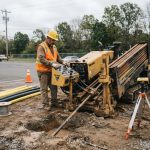
Directional boring, also called horizontal directional drilling, installs pipe, conduit, or cable underground by guiding a drill head along a planned path rather than digging an open trench. Contractors and property owners in Denver, CO increasingly choose this method when surface restoration costs, landscaping, or paved areas make traditional trenching impractical.
For commercial and industrial projects, directional boring services in Denver, CO typically involve fiber optic conduit, electrical systems, and telecom infrastructure installed beneath sidewalks, parking lots, and other developed surfaces. With precision underground boring services by CableEx, this trenchless approach limits the footprint of construction activity while still allowing utilities to pass under existing structures and obstacles.
How the Directional Boring Process Works
Horizontal directional drilling follows a sequence of steps that differ meaningfully from standard excavation work.
- Utility locating – Crews identify existing underground lines before any drilling begins, a step required by safety protocols across the industry.
- Pilot bore – A guided drill head creates a narrow path along the planned route, tracked in real time using electromagnetic equipment.
- Reaming – The pilot hole is enlarged to the diameter needed for the conduit or pipe.
- Pullback – Cable, conduit, or pipe is pulled through the enlarged path, completing the underground installation.
Entry and exit pits are dug at each end of the bore path to allow equipment access and product pullback, even though the main run stays trenchless.
Why Property Owners Choose Trenchless Installation
Open trenching disturbs everything above the dig line, including turf, hardscape, and nearby tree roots. Directional boring avoids most of that disruption by routing underground rather than across the surface.
Common reasons contractors and property owners select this method include:
-
Reduced restoration costs for pavement, landscaping, and concrete
-
Fewer disruptions to business operations during installation
-
Ability to route conduit beneath obstacles such as roads, sidewalks, or existing utilities
-
Shorter overall project timelines compared to trench-and-backfill methods
Safety and Regulatory Considerations in Denver, CO
Even though horizontal directional drilling avoids a continuous open trench, the entry and exit pits used to access the bore path are still regulated as excavations. According to OSHA’s excavation standard, pits that reach a certain depth require protective systems, proper spoil setback, and inspection by a competent person before work proceeds. Crews working in Denver, CO should also confirm utility locates are complete and verified before any drilling starts, since striking a gas or electrical line during a blind bore carries serious risk.
|
Installation Method |
Surface Disruption |
Typical Use Case |
|---|---|---|
|
Open trenching |
High |
Shallow, short-distance runs with easy access |
|
Directional boring |
Low |
Crossing roads, sidewalks, or landscaped areas |
|
Auger boring |
Moderate |
Casing installation under railroads or highways |
Business Info
Network cabling and infrastructure contractor CableEx, Get directions to CableEx, lists directional boring among its underground installation services, alongside structured cabling, fiber optics, and commercial electrical work. Based in USA, the company serves customers across Denver, CO for underground utility and conduit installation projects.
Frequently Asked Questions
What is the difference between directional boring and trenching? Trenching removes soil along the entire utility path, while directional boring guides a drill head underground and pulls conduit through a bored tunnel, leaving the surface largely intact.
Does directional boring require permits in Denver, CO? Utility locates and local permitting requirements generally apply to underground installation work, and specific requirements depend on the project site and utility owner.
Is directional boring suitable for residential properties? The method is commonly used on commercial and industrial sites for conduit and utility runs, particularly where surface restoration costs or access constraints make trenching impractical.
How deep do directional bores typically run? Depth varies by project and the utilities being crossed, with routing planned around existing underground infrastructure identified during the locating phase.
Directional boring remains a practical option for underground installation projects where surface disruption, restoration costs, or site access present challenges. Readers can get directions to CableEx for published location and contact details.