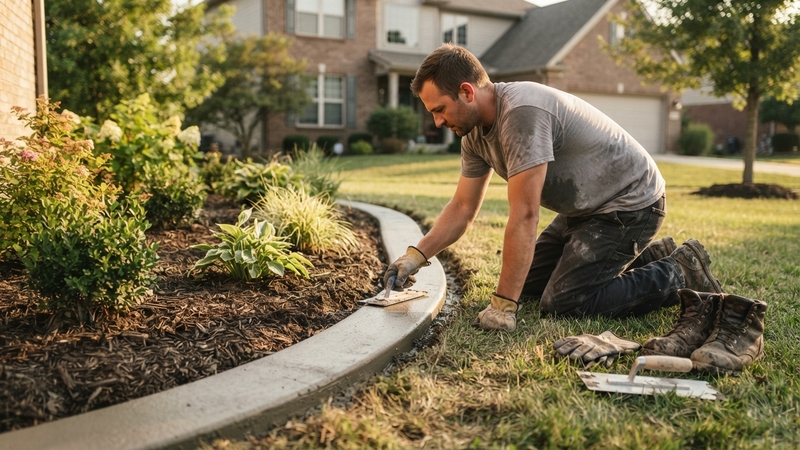
• Decorative concrete curbing creates a permanent, poured-in-place border that keeps mulch, soil, and rock contained while defining clean lines around beds, trees, and walkways.
• It is installed as one continuous piece, custom-colored and stamped, offering more durability than plastic or metal edging.
• Residential and commercial properties across Whitewater, WI, can use this method to reduce yard maintenance and sharpen a landscape’s overall appearance.
A defined, continuous border around flower beds, trees, and walkways is one of the simplest ways to make a yard look organized and intentional. Decorative curbs in Whitewater, WI, refer to poured concrete edging that separates lawn areas from mulch or rock beds while adding a custom color or stamped pattern to the landscape design.
Unlike segmented plastic or metal edging that shifts and warps over seasons, this curbing method is formed on-site as a single continuous strip. That construction method is part of what distinguishes it from pre-cut materials, since the curb is shaped and poured directly along the planned border rather than assembled from separate pieces.
What the Installation Process Involves
Decorative concrete curbing is typically formed using a curbing machine that extrudes concrete directly along a marked path, allowing it to follow curves, slopes, and tight corners around existing landscaping features. The process generally includes a few consistent steps:
• Marking and shaping the border line around beds, trees, or walkways
• Extruding or forming the concrete in one continuous run
• Adding integral color or release colors along the surface
• Stamping a texture, such as brick or stone, into the still-workable concrete
• Allowing the curb to cure before backfilling with mulch or rock
Because the curb is poured as a single piece rather than installed in segments, it resists the gaps and shifting that often appear over time with interlocking or staked edging materials.
Why Property Owners Choose This Border Style
Several practical factors explain the ongoing popularity of decorative concrete curbing over other edging options.
• Mulch and soil containment: A continuous curb keeps loose landscaping material from migrating onto lawns or walkways after rain or mowing.
• Reduced upkeep: Concrete does not require the annual reinstallation that wood stakes or plastic strips often need.
• Design flexibility: Integral colors and surface stamps let a border coordinate with brick, stone, or other exterior finishes.
• Clean sightlines: A single poured edge produces a straighter or smoother curve than segmented materials, which can shift out of alignment.
Seasonal moisture and freeze-thaw cycles in Whitewater, WI, make bed erosion and mulch displacement common concerns for yard maintenance. Soil management practices such as adequate mulch depth and erosion control, as outlined in EPA WaterSense landscaping guidance, support healthier beds, and a stable curb border works alongside those practices by keeping material in place during runoff.
Matching Curb Style to Landscape Goals
| Border Material | Typical Lifespan | Maintenance Needs | Design Options |
| Decorative concrete curbing | Long-term, with proper installation | Low; occasional sealing | Colors, stamped patterns, curves |
| Plastic edging | Short to moderate | Frequent reinstallation | Limited |
| Metal edging | Moderate | Occasional straightening | Minimal |
| Wood border | Short | Regular replacement | Limited |
Selecting a border style often comes down to how much long-term upkeep a property owner is prepared to manage versus the upfront cost of a poured installation.
Business Info
Based in Watertown, WI, Pioneer Curb & Borders serves customers across Whitewater, WI, with residential and commercial concrete curbing installations poured on-site as a continuous border. The company offers multiple stamp and color combinations for custom landscape edging as an alternative to standard plastic edging.
Frequently Asked Questions
Does decorative curbing work on sloped or curved yards? Poured concrete curbing is formed on-site so that it can follow curves, slopes, and irregular bed shapes more closely than pre-cut edging materials.
How long does a concrete curb installation take to cure? Curing time varies by weather and mix, but the curb generally needs to set before mulch or rock backfill is placed against it.
Can decorative curbing be installed around existing landscaping? Yes. The curb is typically formed directly along existing bed lines, walkways, or tree rings without requiring major disruption to established plantings.
Is decorative curbing suitable for commercial properties? Residential and commercial curbing installations both use the same poured, continuous-edge method, adjusted for the scale and layout of the property.