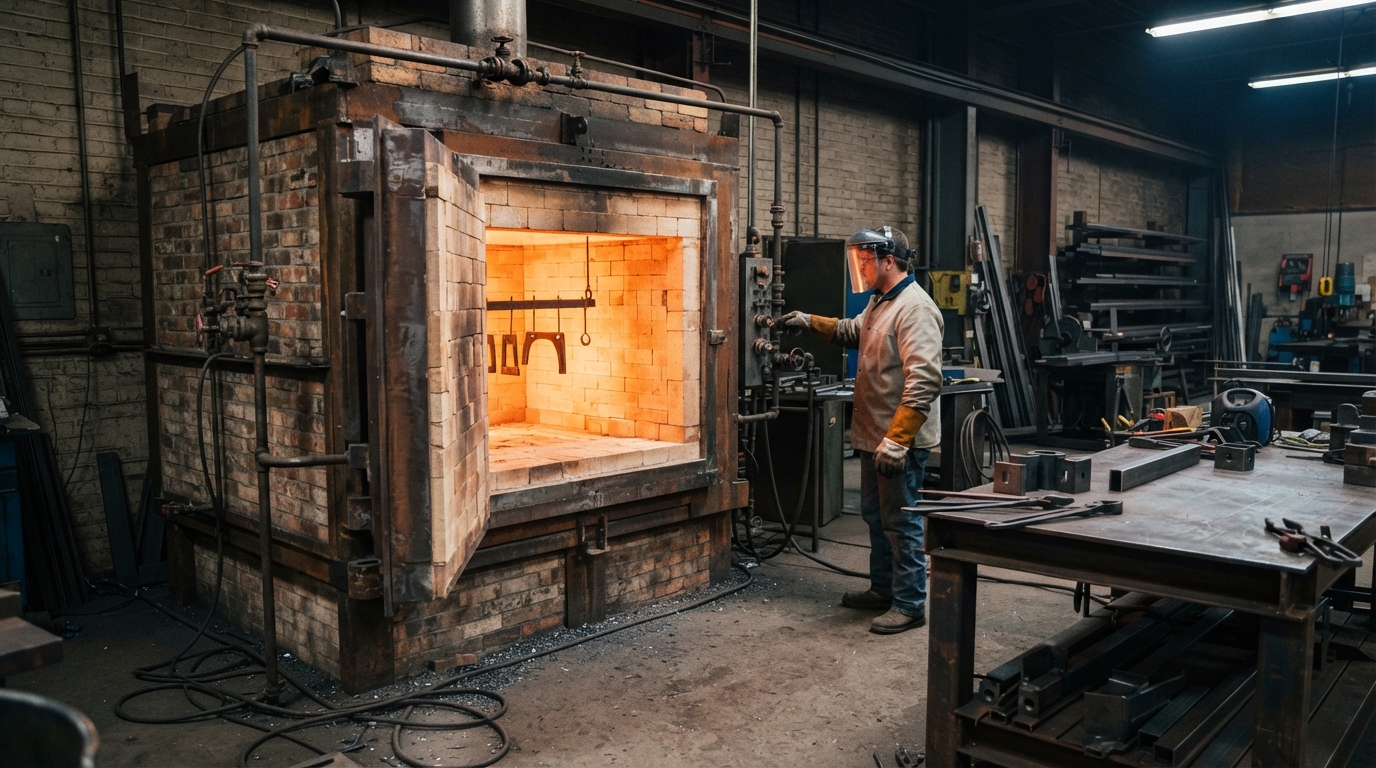
• Heat treating equipment includes furnaces, ovens, and burners that heat, hold, and cool metal to change its hardness, strength, or workability.
• Core components typically include a heat source (gas burner), an insulated chamber, temperature controls, and sometimes a quenching or salt bath system.
• Equipment selection depends on target temperature, metal type, and whether the process is annealing, hardening, or tempering.
Heat treating equipment refers to the furnaces, ovens, and burner systems used to heat metal to a controlled temperature, hold it there, and then cool it in a way that changes its physical properties. This category of industrial equipment supports processes such as annealing, hardening, and tempering, which are used across metalworking, tool and die work, and foundry operations.
Manufacturers that build Heat Treating Equipment typically design chambers and burner systems around specific temperature ranges and insulation needs, since different metals and processes call for different heat profiles. Facilities that work with tool steel, carbon steel, or cast iron generally need equipment rated for higher sustained temperatures than general-purpose process heating applications.
How Heat Treating Equipment Works
Heat treating relies on three basic stages: heating, soaking, and cooling. Each stage is managed by a different part of the equipment setup.
• Heating – A gas burner or electric element raises the chamber temperature to the target range needed for the metal being treated.
• Soaking – The metal is held at temperature long enough for the internal structure to change evenly throughout the material.
• Cooling – The piece is cooled at a controlled rate, often through air cooling, oil quenching, or a salt bath, depending on the hardness or toughness required.
Industrial oven furnaces built for this work are often insulated with firebrick or a combination of firebrick and fiber insulation to manage heat retention and recovery time between cycles. Some systems are rated for use up to roughly 2,000 to 2,150 degrees Fahrenheit, which covers common hardening and tool-room applications for tool steel, carbon steel, and cast iron.
Common Types of Heat Treating Equipment
Different jobs call for different chamber designs, insulation levels, and heat sources. The table below outlines general categories found in industrial settings.
|
Equipment Type |
Typical Use |
Notable Feature |
|
Firebrick oven furnace |
Annealing, hardening tool and carbon steel |
Thick brick mass for stable temperature holding |
|
Hybrid brick-and-fiber furnace |
High-temperature precision casting, tool-room work |
Faster ramp-up and recovery between cycles |
|
Salt bath furnace |
Tight heat-treat windows, quenching |
Rapid, even heat transfer through molten salt |
|
Rectangular melting furnace |
Salt melting for heat treating, tempering, quenching |
Firebrick insulation with a milled steel pot |
Equipment manufacturers in this space, including those based in Cleveland, NY, generally build to order around the burner type, chamber dimensions, and insulation package a given process requires rather than offering a single fixed configuration.
Safety and Operating Considerations
Heat treating involves open flame, molten salt or metal, and surfaces that remain hot well after a cycle ends. Facilities operating this equipment are expected to follow documented safety procedures for burner lighting, quenching, and hot-surface handling. According to the Canadian Centre for Occupational Health and Safety, workers should only operate heat-treating equipment when properly trained and should check that safety devices such as automatic shut-off valves are functioning before lighting a furnace.
Routine maintenance checks typically include:
1. Inspecting gas valves, thermopilots, and combustion controls for wear.
2. Verifying insulation integrity to prevent heat loss or exterior hot spots.
3. Confirming quenching or cooling medium volume is sufficient for the job size.
4. Testing automatic shut-off and exhaust systems before each operating cycle.
Specifications for Charles A Hones, Inc. are published for the local service area, including contact details and facility information.
Frequently Asked Questions
What metals require heat treating equipment? Tool steel, carbon steel, and cast iron are among the most common materials processed through hardening and annealing furnaces, though other alloys can require heat treatment depending on the application.
What temperature range do heat treating furnaces operate at? Ranges vary by equipment design, but many industrial oven furnaces are built for use up to approximately 2,000 to 2,150 degrees Fahrenheit, depending on insulation type and intended process.
Is heat treating equipment custom-built or off-the-shelf? Many industrial burner and furnace systems are configured around a customer’s specific fuel supply, dimensions, and heat output needs rather than sold as one-size-fits-all units.
Where is heat treating equipment manufactured for metalworking clients? Some manufacturers serving metalworking, foundry, and trade school clients operate out of facilities such as those located in Cleveland, NY, producing burners and furnace systems on site.