Simply put:
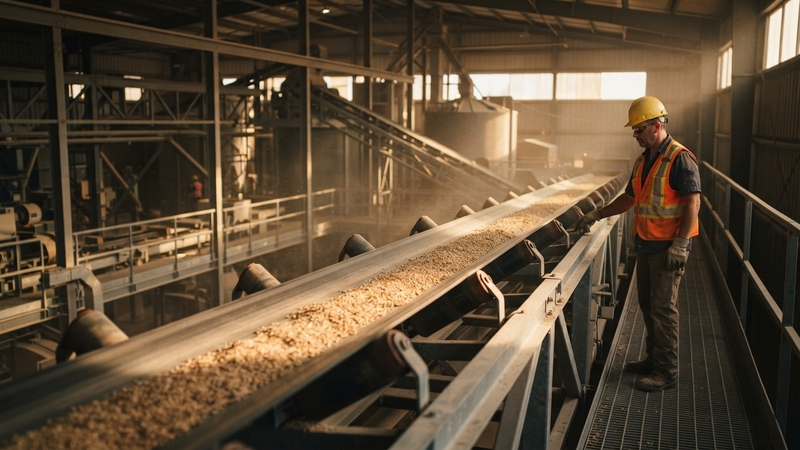
- Belt conveyors move bulk materials such as grain, aggregate, or ore along a continuous rubber or fabric belt driven by powered pulleys.
- They are used across agriculture, mining, and industrial material handling for continuous, high-volume transport over long distances.
- Design choices such as belt width, incline angle, and drive type determine throughput capacity and suitability for a given material.
Belt conveyor systems answer a straightforward engineering question: how to move loose or bulk material from one point to another without manual labor or repeated equipment trips. A continuous loop of belting, supported by rollers and driven by motorized pulleys, carries material from a loading point to a discharge point at a steady, controllable rate.
How Belt Conveyor Systems Work
A belt conveyor relies on a few core components working together. The belt itself, typically rubber, fabric, or a reinforced composite, stretches between a head pulley and a tail pulley, with idler rollers supporting the load along the span.
- Drive pulley – powered by an electric motor, this pulls the belt forward.
- Idlers – spaced rollers that support the belt and prevent sagging under load.
- Loading and discharge points – where material enters and exits the system, often fitted with chutes or skirting to control spillage.
Belt Conveyors are engineered around the specific material being handled, since factors like particle size, moisture content, and bulk density affect belt speed, incline limits, and the type of surface or cleats required to prevent slippage.
Applications Across Industries
Belt conveyors appear in settings where bulk material needs to move efficiently and continuously rather than in discrete batches.
- Agriculture – grain handling facilities use belt conveyors to move corn, soybeans, and other commodities between storage bins, dryers, and loadout points.
- Mining and aggregates – quarries and mine sites rely on belt systems to transport crushed stone, sand, or ore from extraction points to processing or stockpile areas.
- Industrial manufacturing – plants handling raw materials or finished bulk goods use belt conveyors to link production stages without manual transfer.
- Bulk terminal operations – ports and transfer terminals use belt systems for loading and unloading bulk commodities between trucks, rail cars, and storage.
The Occupational Safety and Health Administration notes that conveyor systems, including belt conveyors, require guarding at nip points and pinch points to reduce the risk of worker injury during operation and maintenance.
Belt Conveyor Design Considerations
Selecting the right belt conveyor configuration depends on the material handled and the physical layout of the facility. A few design variables influence performance significantly.
| Design Factor | Why It Matters | Common Range or Consideration |
| Belt width | Determines maximum throughput volume | Narrow belts for lower volume, wider belts for high-capacity operations |
| Incline angle | Affects whether material slides back or spills | Steeper inclines often require cleated belting |
| Belt material | Impacts durability and resistance to abrasion | Rubber, PVC, or reinforced fabric depending on material handled |
| Drive configuration | Influences speed control and power needs | Single or multiple drive pulleys based on conveyor length |
Facilities handling abrasive materials such as crushed rock typically specify heavier-duty belting and reinforced idlers to withstand wear over time. Grain handling operations, by contrast, often prioritize gentle handling to minimize product damage during transport.
Maintenance and Operational Reliability
Belt conveyors require routine inspection to maintain consistent performance and avoid unplanned downtime. Worn idlers, misaligned belts, and damaged splices are among the most common issues that reduce efficiency.
- Check belt tension and alignment on a regular schedule to prevent tracking issues.
- Inspect idlers and pulleys for wear, since a failed idler can cause belt damage if left unaddressed.
- Monitor loading points for buildup or spillage, which can indicate chute or skirting problems.
Equipment manufacturers serving agricultural and industrial markets across the USA design belt conveyor systems to match specific throughput and material-handling requirements, which is why consulting detailed specifications before installation helps match equipment to the application.
Equipment suppliers such as Orthman Conveying Systems list belt conveyor configurations among the material handling equipment available for agricultural and industrial bulk handling needs.
Frequently Asked Questions
What materials can a belt conveyor handle? Belt conveyors handle a wide range of bulk materials, including grain, sand, gravel, crushed stone, and ore, with belt surface and width selected based on particle size and abrasiveness.
How steep can a belt conveyor incline be? Incline limits depend on the material and belt surface; smooth belts handle modest inclines, while cleated or textured belts allow steeper angles without material sliding back.
What is the difference between a belt conveyor and a screw conveyor? A belt conveyor moves material along an open belt surface, while a screw conveyor uses a rotating helical screw inside an enclosed trough, making screw conveyors better suited for confined spaces or finer materials.
How often should a belt conveyor be inspected? Routine inspection schedules vary by facility, but checking belt tension, alignment, and idler condition on a regular basis helps prevent unplanned downtime.
Equipment Specifications
Current belt conveyor configurations and specifications for Orthman Conveying Systems are published for reference by facility planners and equipment buyers.